
As early as 1782, the rich manganese and iron deposits in the region created favorable conditions for their exploitation and the establishment of a metallurgical plant in Iacobeni. In 1796, the "ironworks" and the mining lands of Mount Arșița, along with all the rights acquired by predecessors, were purchased by Anton Manz von Mariensee.
At that time, in Iacobeni, there were a poorly constructed 24-meter blast furnace, two forges, and 12 housing units for workers. In the following period, Manz focused intensively on discovering new subsurface resources, bringing in specialists, and modernizing the material base. In Iacobeni alone, for instance, 280 houses, grocery stores, an Evangelical church, a Catholic church, and an Orthodox church for the locals were gradually built, and significant sums were invested in constructions and equipment required for mining.
Concurrently with the extractions in known locations, the brought-in specialists conducted significant exploration, delineation, and evaluation works of the useful ores. In 1797, they discovered a region rich in argentiferous galena, limonite, and magnetite on the southeastern slope of Mount Fluturica, near Cârlibaba. In the same year, they opened three mines at Rusaia (deposits containing 64–70% iron), Valea Stânei, and Cârlibaba. The mine and ore processing facilities in Cârlibaba were operated until around 1860; however, after 1820, production declined due to the depletion of the deposits, and between 1841 and 1859, it recorded considerable losses. Overall, however, during its 63 years of operation, it yielded an excellent production totaling 2,804,480 kg of lead and 10,000 kg of silver.
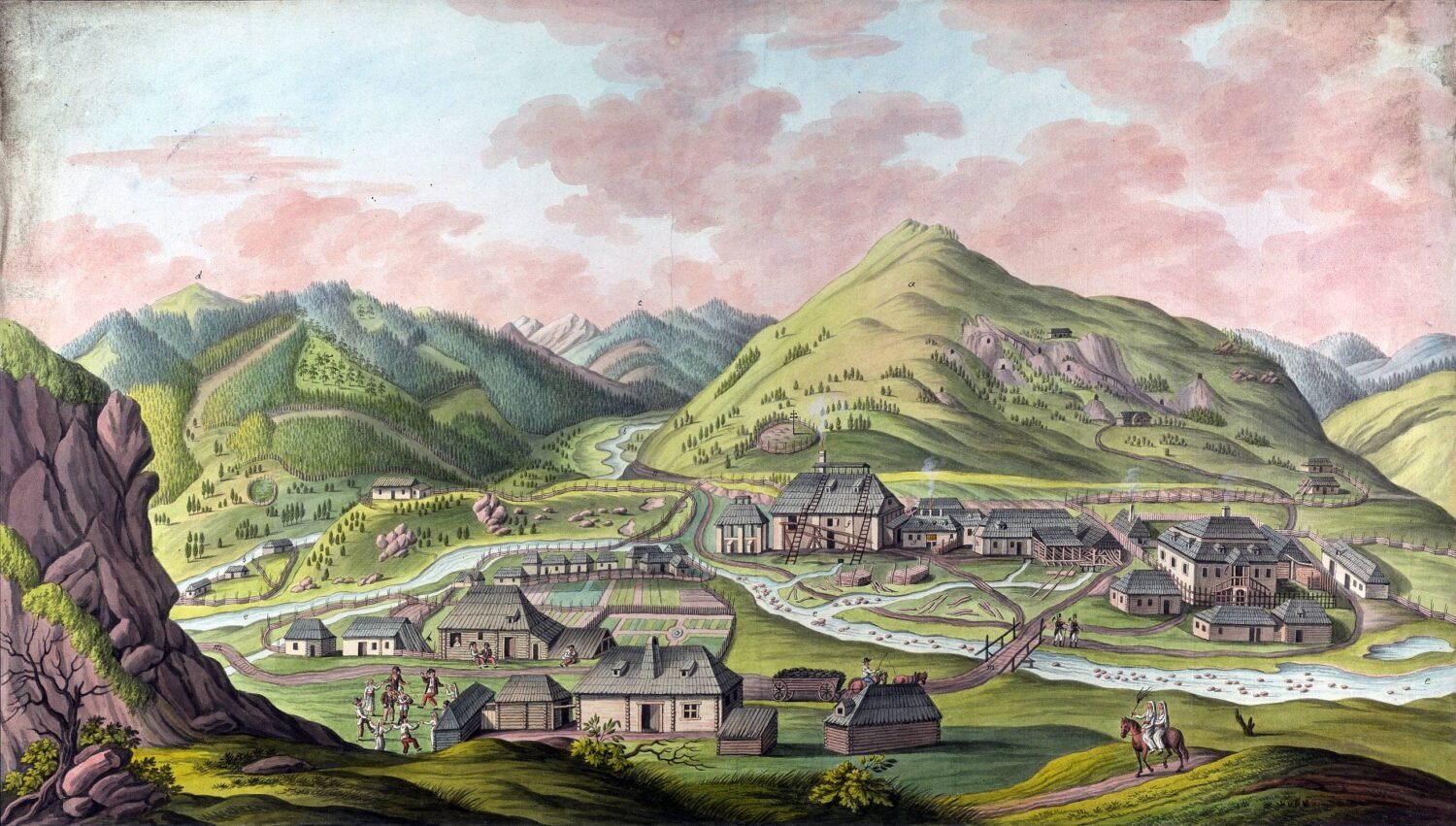
The profit generated allowed for the construction of a new blast furnace and four new ore-crushing hammers in Iacobeni, as well as other hammers and forges in Rus pe Boul and Prisaca Dornei (1807), the acquisition of the copper deposits in Fundul Moldovei and those located between Câmpulung and Iacobeni, along with the "copper smelting plant in Pojorâta" (1821), and the execution of significant investments in the exploration and extraction of iron ore in the Bistrița Aurie basin. After 1800, other perimeters were also put into operation in Valea Stânei, Valea Putnei, and especially in Fundul Moldovei / Dealul Negru—the Dreifaltigkeit (Holy Trinity) mine. This mine, featuring a 1–2 meter vein of pure chalcopyrite tracked through three galleries, remained in operation for nearly 50 years (1805–1854).
With the purpose of developing mining activities and with the support of the authorities in Vienna, Manz brought in foreign miners from the Zips County or Slovakia. This led to the establishment of the "Zipser" colonies in Iacobeni—1784, Cârlibaba (Mariensee, in Bukovina, and Ludwigsdorf, on the Transylvanian bank of the Bistrița Aurie)—1797, Fundul Moldovei (Handal), Pojorâta (Louisenthal)—1805, Prisaca Dornei (Eisenau)—1808, Vatra Moldoviței (Freudenthal)—1809, and Bucșoaia—1810. Houses were built for the colonists, and each received a plot of arable land next to their homestead. Even Manz benefited from concessions from the state: for instance, certain debts of his were canceled, he was granted the use of the meadows and pastures of Suhard and those in Poiana Stampei, and he was permitted to exploit the forestry fund at a modest price.
Parallel to the extraction and processing of ores along the Bistrița Aurie Valley and the upper valley of the Moldova River, mining activities also developed along the Suha and Moldova valleys, downstream from Câmpulung. The iron-rich ores led to the construction in 1825 of a tall blast furnace and an iron foundry in Stulpicani, owned by Carol Kalita; a blast furnace in Vama (Prisaca Dornei), owned by Wolf Kleinberg; as well as two rolling mills in Bucșoaia and Valea Stânii.
In 1827, the entire mining industry developed by A. Manz was inherited by his nephew, Vincenz, who continued the investments and prospecting works. For instance, in 1850, to increase the efficiency of the Colaca Nouă mine, a 12 hp steam engine was introduced to pump water out of the mine and handle shaft transport—marking "the first power engine introduced into mining operations in Bukovina." Specialists continued to be brought in, new blast furnaces were constructed, the older ones in Iacobeni were modernized, workshops were equipped with machine tools, and new lands were acquired. To secure the necessary supply of charcoal for the blast furnaces, he leased the forests on the left bank of the Bistrița River—from its confluence with the Dorna River up to near its headwaters.
Research has established that the extracted ore, once transported to the smelting facility, was introduced into furnaces where charcoal fires were maintained continuously until the ore melted and flowed into a pit dug in the ground. After cooling, the metal was broken into pieces, extracted, and placed in furnaces in successive layers with poplar or willow wood. This operation was repeated 5 to 6 times to separate all impurities. Subsequently, the resulting product was melted two more times in blast furnaces, and only then, finally, were the metals pure—meaning refined. The material thus obtained was transformed, within the owner's own plants, into products destined for consumption. While the exact range of products from the forges and "plants" of Iacobeni is not precisely known, it can be stated that they manufactured and supplied plows, hoes, spades, cauldrons, stovetops, ore-refining grates, forge hammers, as well as all assortments of iron tires and even spare parts for machinery. Through the continuous development of mining installations, the construction of blast furnaces for smelting iron, lead, silver, or copper, of ore-refining furnaces, of stamps for crushing ore, forges, and water pipelines for cooling or producing the motive power needed for the blast furnace bellows, a true metallurgical industry had been created in Bukovina by the mid-1820s.
In 1858, the Manz mining empire in Bukovina comprised nearly 100 facilities, including "3 tall blast furnaces for smelting iron in Iacobeni, 2 silver and lead smelting furnaces in Cârlibaba, 8 copper smelting and refining furnaces in Pojorâta, 11 iron finery forges in Iacobeni and its surroundings, 10 finery forges in Prisaca Dornei (Eisenau), 10 near Vatra Moldoviței (Freudenthal), a machine manufacturing plant in Iacobeni, 7 workshops for producing hammers, 7 blacksmith shops for horseshoeing, a forge for nails, 2 locksmith shops, 10 workshops for producing mining picks, 16 workshops for manufacturing ore-reduction grates, 5 mills for crushing ore, 8 warehouses for goods and provisions, 2 administration buildings, 60 houses for officials, 5 churches, 8 schools, 2 pharmacies, 807 houses for colonists, 10 splash dams, 25 bridges, 14 water pipelines, and 44 miles of roads."
Around this period, the decline also began, as a result of the depletion of reserves with a high content of useful substances—copper, lead, and silver—competition and the loss of certain markets, political and military events, etc. To save the industrial estate, large loans were taken out, but to no avail. In 1862, bankruptcy proceedings were opened, lasting nearly 10 years. After a decade of inactivity, during which time their value continuously decreased, at the end of 1869, the mining installations and the iron and copper mines scattered over an area of 2,000 hectares in the mountains around Pojorâta, Fundul Moldovei, Colacul, Arșița, on Mount Runc, in Vatra Dornei, Vama, Valea Stânei, etc., were acquired by the Church Fund (the largest creditor) for a negligible sum.
Along with the decline of mining, the Zipser settlements also deteriorated. They abandoned the practice of mining and dedicated themselves to other occupations—those along the Bistrița Valley chose timber rafting, those in the Moldova and Moldovița valleys became forestry workers or sawmill laborers, while others became farmers or seasonal workers in neighboring Moldavia.