
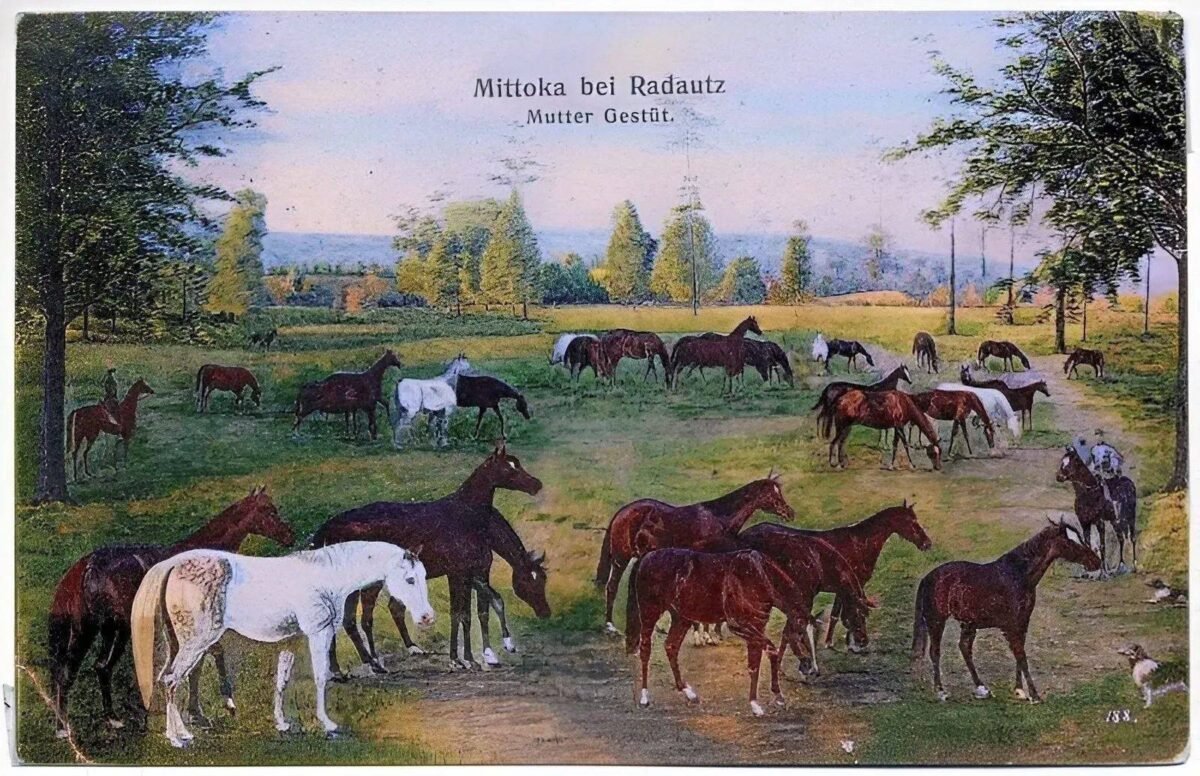
As early as 1792, the Aulic War Council recognized the extraordinary advantages of the Rădăuți estate for sheltering a military stud farm. Consequently, it was entirely leased for unrestricted use. Throughout the roughly 60 years of administration, several establishments designed for the breeding and reproduction of army horses were created. The first winter shelters were built in Vadul Vladichii, Mitoc, Voitinel, Vicovul de Sus, and Frasin, followed later by those in Milișăuți, Burla, Volovăț, Horodnicul de Sus, Frătăuții Vechi, and Frătăuții Noi. By 1851, there were 22 brick stables and 9 wooden ones.
In the summer, the horses were stationed on the pastures of the Lucina and Bobeica mountains, where they benefited from the best feed. The stallions were initially of Transylvanian breed, but later, several Norman stallions were brought to Rădăuți; through them, the horses grew in size and power, and by the mid-nineteenth century, almost exclusively Arabian thoroughbreds were purchased. Alongside the military stud farm of the Rădăuți estate, other state stud farms operated, uniformly distributed throughout the province, as well as a few private ones (especially in the northern half). Annual fairs were held in Rădăuți (before the Feast of St. George) and Chernivtsi (before the Feast of St. Peter and Paul), where the owners of the finest specimens were awarded prizes. Generally, these owners were German colonists who paid greater attention to the care and diet of the horses—aspects that were reflected in their size, endurance, and beauty. Smallholders were less concerned with these details. Their horses, raised in the open air and with meager feed, were small and unappealing in appearance, yet more resilient to unfavorable weather and harsh working conditions. Despite their small stature, the mountain horses of the Hutsuls stood out for their power and endurance; they were used for transporting baggage even on the most difficult trails, as well as for teams in the lowlands.
Bukovinian cattle, much like those in the neighboring countries to the east, belonged to the Podolian-Hungarian variety, from the so-called lowland breed. Their meat, fat, and hides were considered excellent, while they were also highly useful for labor. Large landowners engaged in their breeding and fattening were located in Doroschoutz, Zastawna, Horoschoutz, Hliboka, Zadowa, Berhomet pe Sereth, and in the mountains of Russian Câmpulung (Câmpulung Rusesc). Smallholders needed oxen primarily for fieldwork, without giving them any special attention. Just as with the horses, they were left to graze on communal pastures. More attractive animals were specific to the Siret or Suceava valleys, particularly in the vicinity of salt springs. The Bukovinian cattle breed was not notable for its milk yields; the milk was consumed or processed into butter, clarified butter, whey, and curd cheese. Despite the large number of mountain pastures, Bukovina did not excel in the dairy industry; two Swiss-style experimental dairy farms established at Vatra Moldoviței and Lăpușna failed within a short time.
The majority of the native population preferred the meat and milk derived from sheep farming—animals that were much less demanding regarding food or sheltering conditions (they even spent the winter outside the stable). A significant portion of the meat was smoked and sold as pastrami in Vyzhnytsia, Siret, and Suceava. Until the end of August, most of the milk was processed into cheese and urdă (whey cheese), which, alongside mămăligă (polenta), formed the staple diet of the rural population. Sheep's milk, milked from the beginning of September, was soured and consumed under the name of Huslenka. The wool was used locally for clothing manufacturing, while the rest was sent to Galicia. Only around Vașcăuți or Ocna were there larger herds of Merino sheep, which supplied markets in Moravia or Silesia.
Prior to the stricter enforcement of forestry laws, goat farming was highly important in Bukovina, as no other domestic animal provided such significant benefits to the smallholder at an extremely low maintenance cost. The introduction of criminal regulations against forest damage led to extensive restrictions on goat raising, resulting in a decline in their numbers.
Pigs were raised in large numbers in the lowlands of Bukovina. Their fattening was also carried out by smaller owners, partly for their own consumption and partly for sale. Almost every owner could feed a few such animals in the fall with pumpkins, cabbage, and other vegetable waste or corn. Smoked meat, ham, bacon, and lard were important export items to Galicia and the German provinces. Pig farming was a traditional activity of the Hungarian colonists, but also of the Lipovans, who were primarily engaged in trading.
A widespread activity was also poultry farming—geese, ducks, chickens, turkeys, and even pigeons
Fisheries were in decline by the mid-nineteenth century, but significant quantities of carp, Crucian carp, tench, pike, perch, trout, bream, catfish, or sterlet were still caught annually along the Dniester. However, the demand was not met, making imports necessary. It is worth noting that two-thirds of the existing ponds between the Prut and Dniester rivers had already been abandoned for sanitary reasons or to better utilize the soil.
Beekeeping was favored in the lowlands (especially the Siret and Suceava valleys) by the large areas occupied by gardens and meadows, the abundance of linden trees, and the climatic conditions (a warm and dry fall). This activity was also in decline. The honey trade was primarily managed by the Lipovans.